4 Consortium Structure
iRISE has established a well-defined project management and governance
structure to ensure the efficient organization of the project,
facilitate decision-making processes, and foster collaboration in line
with the project’s description of action. Our consortium management
structure consists of the following key roles:
Project Coordinators: iRISE is co-coordinated by Dr Sarah McCann
(Charité) and Professor Emily Sena (UEDIN). McCann and Sena are
responsible for overseeing the project as a whole, ensuring alignment
with its objectives, maintaining quality, adhering to the project
schedule, and managing the budget. Additionally, McCann, as the
designated coordinator in the Grant Agreement, serves as the primary
contact point for the European Commission.
Supported by the Project Management Office (PMO), the BIH QUEST Center
Office Administration Team, and the Research Grants Office at Charité,
the co-coordinator’s main responsibilities are to: (1) ensure efficient
project management; (2) guide the project’s decision-making process; (3)
alternate chairing of the Steering Committee and lead the set of
activities to be carried out by this committee; (4) coordinate
technical/support activities across work-packages; (5) maintain and
regularly update the contents of this project management handbook to
support quality and timely delivery of iRISE deliverables; and (6) act
as the Financial Officer within the Consortium, including managing the
preparation of financial statements for the Commission.
Project Manager (Rebecca Fischer, MIK): The Project Manager is
responsible for the day-to-day coordination and administration of the
project. She will ensure that the management procedures as defined below
are carried out throughout the project’s lifetime and that supporting
tools and templates will be made available. Management tasks include
consolidation of the project planning, progress reports, milestone
monitoring, financial management, etc. by gathering and aggregating
inputs from the project partners. The project manager should be the
first point of contact for project iRISE enquiries and will direct
enquiries to the relevant persons or information sources.
Project Management Office (PMO): The PMO, consists of the
Co-coordinators (McCann and Sena) and the Project Manager (Fischer). The
PMO will work collectively to successfully manage the project to meet
our objectives, milestones and deliverables. They are responsible for
financial management, modifications to the grant or consortium
agreements and collecting information for the purposes of reporting to
the European Commission. The PMO is also responsible for the
organisation of project meetings, including ensuring work package and
steering committee meetings are held, and the planning and chairing of
the annual iRISE General Assembly. The PMO will meet at least monthly to
ensure its effective performance.
Steering Committee (SC): Comprising eight members, the iRISE SC
includes each of the work package leads: McCann (Charité), Sena
(UEDIN), Heyard (UZH), Fanelli (HW), Wever (RUMC),
Marušić (MFEST), Miller (MIK) and Currie (UEDIN). The SC is
responsible for the implementation of the project, quality management
and is the highest decision-making body of the consortium. The main
responsibilities of the SC include: (1) the definition of the overall
project strategy; (2) fulfilling the Commission requirements pertaining
to preparation of progress and financial reports; (3) deciding on
long-term exploitation plans; (4) conflict resolution within the
Consortium, in line with the details described in the iRISE Conflict
Resolution Policy; (5) technical coordination and decision-making
(assessment of the technical work, interchange of technical information
amongst partners, submission of deliverables, etc.); and (6) risk
management. The SC will meet quarterly, requires 2/3 majority for
quorum, with decisions reached through a simple majority process.
Work Package (WP) Leads: iRISE comprises seven WPs, each led by 1-2
individuals. The leads are:
- WP1 - Heyard (UZH), Fanelli (HW),
- WP2 and WP7 - McCann (Charité), Sena (UEDIN),
- WP3 - Miller (MIK),
- WP4 - Marušić (MFEST),
- WP5 - Wever (RUMC), and
- WP6 - Currie (UEDIN).
WP leads are responsible for ensuring the delivery of their WP
objectives. They are responsible for implementing and managing tasks and
providing guidance and support to task leads as appropriate. They are
responsible for ensuring regular, timely and effective communication
between all members of the WP, including the organisation and chairing
of WP meetings. They oversee the risk management for all tasks within
the work package and are responsible for all technical aspects of their
WP (meeting of milestones, timely submission of deliverables and
reports, and the quality assurance of all WP outputs). WP leads also
provide reports back to steering committee.
Task Leaders: Work within WPs is divided into tasks with designated
task leaders. Task leaders are responsible for the technical management
of specific activities, including planning, monitoring and reporting to
the WP leader. Each individual partner holds ultimate responsibility for
the technical and administrative outputs assigned to them.
| WP | Task | Lead |
|---|---|---|
| 1 | 1.1 Background scoping and framing | Bernhard Voelkl |
| 1.2 Modelling irreproducibility causes and remedies | Daniele Fanelli | |
| 1.3 Validating statistical methods to assess and improve reproducibility | Rachel Heyard | |
| 1.4 Empirical meta-meta-studies | Rachel Heyard | |
| 1.5 Testing meta-scientific predictions | Daniele Fanelli | |
| 2 | 2.1 Create a Systematic Online Living Evidence Summary (SOLES) of candidate interventions | Kaitlyn Hair |
| 2.2 Perform systematic reviews of interventions that have been evaluated for effectiveness | Sarah McCann | |
| 2.3 Develop a framework to evaluate candidate reproducibility interventions | Carlijn Hooijmans | |
| 3 | 3.1 To provide a cross-cutting “support service” that lends a research culture and EDI lens to other WPs | Stephanie Zellers |
| 3.2 Identifying areas of underrepresentation in research practitioners and participants | Katharina Miller | |
| 3.3 Defining the characteristics of those currently engaged in reproducible research | Maia Salholz-Hillel | |
| 3.4 Develop a framework to determine the EDI impacts of interventions | Maia Salholz-Hillel | |
| 3.5 Explore how EDI considerations intersect with diversity of research culture | Daniele Fanelli | |
| 3.6 Gather missing data for a best practice guideline | Maia Salholz-Hillel | |
| 4 | 4.1 Create a priority map of practices and tools | |
| 4.2 Identify facilitators and barriers to introducing practices and tools | ||
| 5 | 5.1 Study design optimisation and protocol registration | Rachel Heyard |
| 5.2 Automated screening tools to improve reporting | Tracey Weissgerber | |
| 5.3 Computational reproducibility review | Gustav Nilsonne | |
| 5.4 The EQIPD Quality System | Björn Gerlach | |
| 5.5 Statistical interventions | Hanno Würbel | |
| 5.6 Output synthesis | Kim Wever | |
| 6 | 6.1 Develop a plan for dissemination and exploitation including communication activities | Gillian Currie |
| 6.2 Develop a data management plan (DMP) | Rachel Heyard | |
| 6.3 Develop a framework to integrate different types of data on the effectiveness of interventions for reproducibility and provide a final reflection on project experiences | Gillian Currie | |
| 6.4 Provide a policy briefing to summarise the policy options to increase reproducibility with recommendations | Daniele Fanelli | |
| 6.5 Create an open knowledge base | Sarah McCann | |
| 6.6 Deliver Train-the-Trainer courses | Katharina Miller | |
| 6.7 Foster relationships with stakeholders to facilitate collaboration, alignment of practices and joint action to increase reproducibility | Gustav Nilsonne | |
| 7 | 7.1 Project management, communication and meeting organisation | Rebecca Fischer |
| 7.2 Contract management, reporting and financial management | Rebecca Fischer | |
| 7.3 Project governance, support of the project bodies and advisory board | Sarah McCann | |
| 7.4 Gender monitoring, research ethics, risk and quality management | Marina Mattera | |
| 7.5 Internal and external co-ordination and liaison | Sarah McCann |
Scientific and Ethical Advisory Board (SEAB): The SEAB comprises
international experts representing five stakeholder groups (i.e.,
researchers, publishers, infrastructure providers, funders and research
networks) who have demonstrable interest and expertise in
reproducibility. The SEAB provides strategic, ethical and scientific
advice, offering valuable feedback on our progress to advance our aims.
We will consult the SEAB on certain aspects of the project to ensure
that what we are producing is fit for purpose and useful for the
community. After each General Assembly, the co-coordinators meet with
the SEAB for a more in-depth discussion of performance, ethical
concerns, and further guidance. The SEAB acts in an advisory capacity
without voting rights or decision-making power.
Confirmed members of the SEAB are:
| Representing | Name | Organisation (country) |
|---|---|---|
| Publisher | Catriona MacCallum | Wiley (UK) |
| Funder | James Morris | Science Europe (Belgium) |
| Infrastructure Provider | Tim Errington | Open Science Framework (USA) |
| Research Network | Antonia Schrader | Reproducibility Networks in Europe |
| Research Network | Flavio Azevedo | Framework for Open and Reproducible Research Training (FORRT) |
| Researcher | Kelly Cobey | University of Ottawa (Canada) |
Stakeholder Forum (SF): We have established a SF that includes wide range of relevant stakeholders that includes: UK Reproducibility Network, Swiss Reproducibility Network, Slovak Reproducibility Network, German Reproducibility Network, Australian Reproducibility Network, Finnish Reproducibility Network, Italian Reproducibility Network, Norwegian Reproducibility Network, ReproducibiliTEA, RIOT Club, MetaMelb Research Group, David Moher (Centre for Journalology, Ottowa Hospital Research Institute), Thomas Steckler (Janssen), The Open Research Funders Group, Ensure Value in Research Group, Science Europe, Wiley, BMJ, Springer Nature, PLOS, Hindawi, University of Oxford, British Neuroscience Association, Janssen Pharmaceuticals, CERN, EATRIS, Centre for Open Science.
Representatives from the Stakeholder Forum are invited to General Assemblies where we will facilitate dialogue for reflection on our approaches and outputs. The SF will help shape our actions to ensure workable/feasible/appropriate activities and this interaction will foster support from the wider community, as shown on Figure 1.
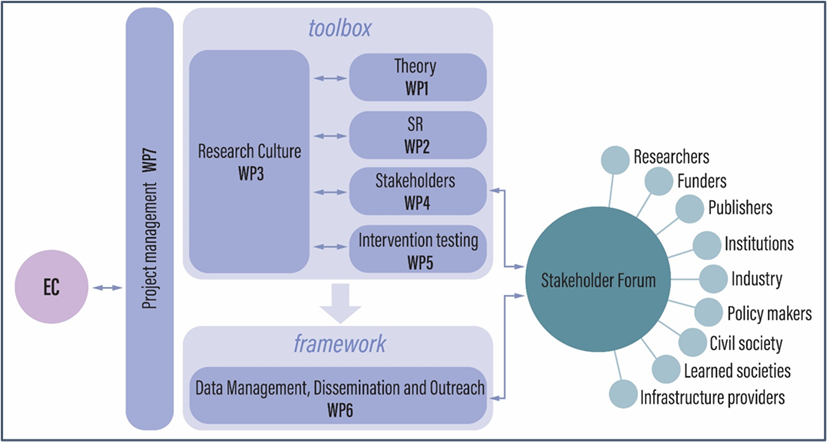
Figure 1. Graphical depiction of the iRISE consortium management structure
4.1 Project Plan
A well-structured project plan serves as a roadmap to achieve our
objectives and milestones efficiently. This section provides guidance
and descriptions on the iRISE project plan, including work package
descriptions, tasks, milestones and timelines. The Description of
Action
(DoA)
and iRISE Grant
Agreement
include this information in detail.
Work Package Descriptions: Each work package (WP) is a critical
component of the iRISE project. WP descriptions outline the purpose,
scope, and tasks of each AP. Work package leaders and team members
should use these descriptions as a reference for their responsibilities.
Aligning work packages with the overall project objectives is
essential.
Task Plans: Tasks are the building blocks of work packages that
describe the individual activities. Individuals are assigned
responsibilities within tasks and clear timelines for each task are set
considering dependencies between tasks and work packages.
Milestone Definition: Milestones represent significant project
achievements. They are Specific, Measurable, Achievable, Relevant, and
Time-bound (SMART). Milestones help track progress and ensure alignment
with the project’s objectives.
Budget Plan: Substantial time and consideration were given to budget
planning for the successful execution of iRISE. The budget plan is
detailed in the Grant Agreement. Eligible expenses and how to monitor
and report on budget use are also detailed in the Grant Agreement and we
encourage consultation with your European Research Office (or
equivalent) to assist with ensuring partners keep within their allocated
budget.
Risk Management: It is critical that project risks are identified
and managed, including a description of mitigation plans.
Change Management: Over the lifetime of iRISE, things may evolve and
require changes to the project plan. Anticipated changes must be
communicated to the Project Management Office (PMO) as early as possible
and must include details of the requested change with an evaluation of
the impact of changes on project goals and timelines.
Quality Assurance: Maintaining the quality of iRISE deliverables is
essential throughout the project’s lifecycle. The strategy for quality
control and quality assurance activities is described in further detail
in the Deliverables section of this handbook.
Collaboration and Communication: Effective communication and
collaboration are essential for project success. Tools and platforms for
sharing project information and strategies are described in detail in
the Communication and Reporting section of this handbook.